Nominal Interest Rates, Price Level changes, and the Real Interest Rate
Saturday, March 21, 2015
Monetary Policy (money market, loanable funds, investment, AD/AS) & real interest rates
So lately I've been trying to increase my understanding of how fiscal and monetary policies work in tandem. I've been a bit dismayed as many students can't understand the Real interest Rate questions on the AP exam and I haven't found any resources that string it all together.
So I've spent a few days working through the past FRQ's and Multiple choice sections of exams in hopes of clarifying exactly what the college board is testing.
1st Monetary Policy
On the left is an explanation of the causal chain of events. On the right is a graphical illustration of the left side. Sometimes seeing what happens in graphs makes the left side a bit more clear. Hope this helps,,, any mistakes, corrections, comments,, wcwaugh@aol.com
So lately I've been trying to increase my understanding of how fiscal and monetary policies work in tandem. I've been a bit dismayed as many students can't understand the Real interest Rate questions on the AP exam and I haven't found any resources that string it all together.
So I've spent a few days working through the past FRQ's and Multiple choice sections of exams in hopes of clarifying exactly what the college board is testing.
1st Monetary Policy
On the left is an explanation of the causal chain of events. On the right is a graphical illustration of the left side. Sometimes seeing what happens in graphs makes the left side a bit more clear. Hope this helps,,, any mistakes, corrections, comments,, wcwaugh@aol.com
Wednesday, March 18, 2015
Fiscal Policy (Loanable Funds) FRQ Cheat Sheet
Some students have a conceptual problem with understanding this section (to many things to think about at this point in the course I think.
Anything that makes money flow into the commercial banks is an increase in the supply of loanable funds and therefore the real interest rate will fall, (more of a supply of something the price falls, ) more money supplied and the price (interest rate) will fall.
Notice that each question is in two places.
2014 is in the Supply decreasing (interest rates rise) and in demand increasing (interest rates rise)
2013 is in the supply increasing (interest rates fall) and the Demand decreasing section (interest rates fall).
Both answers would be correct unless on the AP exam they ask you specifically what happens to supply. 2014 would then be a supply increasing explanation with a correct graph.
Some students have a conceptual problem with understanding this section (to many things to think about at this point in the course I think.
Anything that makes money flow into the commercial banks is an increase in the supply of loanable funds and therefore the real interest rate will fall, (more of a supply of something the price falls, ) more money supplied and the price (interest rate) will fall.
Notice that each question is in two places.
2014 is in the Supply decreasing (interest rates rise) and in demand increasing (interest rates rise)
2013 is in the supply increasing (interest rates fall) and the Demand decreasing section (interest rates fall).
Both answers would be correct unless on the AP exam they ask you specifically what happens to supply. 2014 would then be a supply increasing explanation with a correct graph.
Tuesday, March 17, 2015
Fiscal Policy (2010 AP Multiple Choice Questions)
Answer (A) Increasing government expenditures to build highways
All of the others are monetary policy.
Answer (B) It is the accumulation of past and current budget deficits and surpluses.
Answer (A)
Lower business taxes mean lower costs for business. AS curve shifts right (input costs decrease, PL decreases) & MC curve shifts right, and to produce at profit max, (produce more) a business must higher more labor. In an imperfectly competitive firm price will decrease.
Answer (B) gov't borrowing to finance its spending decreases private sector investment.
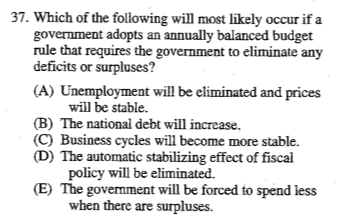
Answer (D) the automatic stabilizing effect of fiscal policy will be eliminated
Answer (C) decrease income taxes and increase gov't spending by equal amounts.
Monday, March 16, 2015
Unemployment, Inflation, Phillips Curve Cheat Sheet & FRQ Cheat Sheet
Unemployment, Inflation, Phillips Curve Cheat Sheet
Understand what happens with the Phillips curve when AD/AS changes.
Sunday, March 15, 2015
Unemployment, Inflation & the Phillips Curve (2010 Multiple Choice Questions)
Answer (C) approximately increased by 10%
The worker received a 20% raise. Inflation ate up 10%, so his real wages increased by 10%.
Answer (B) an increase in inflation
A decrease in unemployment (8% to 6%) results in a movement up the SRPC indicating an increasing PL.
Answer (C) 8%
Nominal Interest Rate 8% = Real IR (3%) + Expected Inflation (5%)
Answer (D) structural employment
Technology eliminates jobs so that workers have to be retrained or reeducated = Structural unemployment.
Answer (C) discouraged workers
Only those looking for work are counted as unemployed. Discouraged workers are not looking.
Answer (D) a recent college graduate who is looking for her first job.
Answer (C) it is vertical at the Natural Rate of Unemployment (NRU)
Subscribe to:
Comments (Atom)