Showing posts with label GDP. Show all posts

Tuesday, April 14, 2020

ALL GDP FRQ's

ALL GDP FRQ's


2011B AP Macroeconomics Exam

(A.) 2009 is the base year calculate the following
(i) NGDP in 2010

NGDP = P x Q
so, 8 x 2.5 = $20
10 x 10 = $100
5 x 5 = $25
Total 2010 NGDP = $145
(ii) The Real GDP in 2010
We find the RGDP 
by using the quantity produced in the current year x prices of the base year
2.5 x 8 = $20
6 x 10 = $60
4 x 5 = $20
RGDP 2010 = $100

(B.) If one years price index is 50 and in the next year the index is 55, what is the rate of inflation from one year to the next?

Rate of Change Formula ((New - Old)/Old) x 100
55-50 = 5
5/50 = .1 x 100 = 10
rate of inflation = 10%

I also like the method in this scenario of doubling both numbers
50 x 2 = 100
55 x 2 = 110
rate of inflation from one year to the next = 10%

this works well if you can divide by 2 also
if the price index = 200 one year and 250 the next
200/2 = 100
250/2 = 125
Rate of inflation from 100 to 125 = 25% inflation

(C.) Next years wages will be 3% higher, but the actual inflation rate is 4%. At the beginning of next year will the real wage be higher or lower or the same as today?

If we get a raise and Nominal Wages increase by 30% we are very happy
but ,, if the PL (Inflation) rises by 4%, all things are 4%more expensive
then we are worse off even with our wage increase
Our Real wages fell by 1%


(D.) Sara gets a fixed rate loan from a bank when the expected inflation rate is 3%.
If actual inflation is 4%who benefits from the unexpected inflation, Sara, the Bank or neither?

If Sara got a loan at 3% and actual inflation is more than expected then Sara benefits
for now she is paying back money that has a lower purchasing power


2008B AP Macroeconomics Exam

(A.) Calculate the NGDP.
NGDP = P x Q
400 x $6 = $2,400
1,000 x $2 = $2,000
800 x $2 = $1,600
NGDP = $6,000


(B.) GDP Deflator is 100 in the base year,, and 150 this year. Calculate each of the following.

(i) The inflation rate, expressed as a percentage, between the base year and this year.


Rate of Change Question
100 to 150 = 50% increase

(ii) This years RGDP
If given the NGDP and the Index (CPI or Deflator)
NGDP/Index = RGDP
6,000/1.5 = $4,000


(C.) The workers received a 20% increase in nominal wages, but workers face the inflation you calculated in B(ii), what happened to their real wages?

Nominal - Inflation = Real
Nom Wages increase by 20% (Yippe) but inflation (the price of everything) went up by 50%
your real wages fell by 30%
Your real wages = the actual goods you can buy after the inflation increase


(D.) If the GDP deflator increases unexpectantly, would a borrower be better off , worse off, Explain.

If you borrow and inflation increases, you are paying back the loan with money that can buy less stuff
Ha, ha, take that lender.
The borrower benefits.

Cheat sheet for inflation here


2007 AP Macroeconomics Exam

(A.) Vale if a used textbook. 
No, Why? Used - already counted in previous year

(B.) Rent Paid in 2006 by resident in an apartment building built in 2000.

Yes, Why? Rent is a service in the market economy.

(C.) Commissions earned in 2006 by a stock broker.

Yes, Why? Commissions are a service in the market economy.

(D.) The value of an automobile produced in 2006 in South Korea by a firm fully owned by the US citizens.

No, Why? Produced in a foreign country (not domestically produced)


Friday, February 17, 2017

2012 Macro Multiple Choice - GDP

2012 Macro Multiple Choice - GDP


(A) An increase in real per capita gross domestic product

(B) nominal per capita GDP has more to due with inflation increase
(C) Price stability - all can be poor and prices stabile 
(D) A balanced budget - Taxes collected = government expenditures - doesn't really speak to standards of living.
(E) CPI - has to due with inflation,, and an increase might have made people worse off.


Answer - (D)


GDP = C + I + GS + XN

Consumption = $3000
Investment = $700
GS = $1,000
XN = Exports - Imports = 300 - 500 = -200

$3,000 + $700 + $1,000 + 300 - 500 = $4,500

Answer - (A) $4,500

Monday, November 14, 2016

2008 B Macro FRQ #3

2008 B Macro FRQ #3


Watch me answer it here

(A) Calculate this year's nominal gross domestic product (GDP).

The GDP Cheat Sheet here.

Nominal GDP is simply this years GDP,    
Price of the goods this year multiplied by the quantity produced

(B) Assume that in Gala Land the GDP deflator (GDP price index) is 100 in the base year and 150 this year. Calculate the following.

(i) The inflation rate, expressed as a percentage, between base year and this year.

It should be clear that inflation increased by 50%. I don't know how to say this differently or better or clearer. Someone should help me.

(ii) This years real GDP.

So, if they had gave us base year prices and another years quantity, we would have used this formula.
but they didn't so,
We have to understand that Real GDP means taking into account the level of inflation. Prices have risen by 50% this year.

It is easy to think that since prices rose by 50% that we should just half the 6000 and say that the real GDP is 3000 (and that would be incorrect)

BUT, recognise that $4000 x 50% rise in prices would be, $4000 x .5 = $2000 and $2000 + $4000 = $6000.


(C) Since the base year, workers have received a 20% increase in their nominal wages. If workers face the same inflation rate as was calculated in (b) (ii) (50%), what has happened to real wages? Explain.

If workers get a 20% raise but prices of all the things they buy rise to 50%, then their real wages have dropped by 30%. Remember that real wages take into account inflation.

from the cheat sheet.


(D) If the GDP deflator in Gala Land increases unexpectedly, would a borrower with a fixed interest rate loan be better or worse off? Explain.

If the GDP deflator increases then inflation has increased. A borrower would be paying back money that is able to purchase less goods, therefore the borrower would  be better off. You bought a good that would now, cost you, significantly more money. 


Friday, October 28, 2016

2007 Macroeconomics FRQ#3

2007 Macroeconomics FRQ#3


Watch me answer it here

(A) The value of a used textbook sold through an online auction in 2006.


Check out GDP cheat sheet, Here

Used means second hand and implies that the value of this textbook was already counted in a previous year, therefore it is not counted this year.


(B) Rent paid in 2006 by residents in an apartment building built in 2000.

Rent is payment (income earned) for the service of using someones property therefore it is counted in GDP for 2006.


(C) Commissions earned in 2006 by a stockbroker. 

Commissions paid on sale (a service) of stock or bonds,,, above.


(D) The value of an automobile produced in 2006 entirely in South Korea by a firm fully owned by US citizens.

from the cheat sheet - 
((Total Value of all Final goods and services produced in the US in a year))

Excludes - production outside the US even by Americans,


Wednesday, December 23, 2015

Nominal vs. Real (Wages, Income)

Nominal vs. Real (wages, income)


To understand Nominal and Real we must first understand the concepts of Inflation and Purchasing Power


Inflation is an increase in the average price level of goods and services in a nation over time.
(If the price of apples is increasing, and the reason is because of a flood or a drought, then this is not spoken of as inflation as the cause is specifically from a flood/draught) If the price of all goods in the country are rising then we have Inflation. (Often caused by increases in the supply of a country's currency)


Purchasing Power is the number of goods or services that can be purchased with a unit of currency.


Nominal wages = current wages    

Nominal wages (Income) is the amount of money I am paid at a certain period of time.  If I'm paid $12 an hour, then my nominal wage is $12 dollars and hour. A nominal wage is expressed in the country's currency.  If apples cost $1 each, then I have the ability (purchasing power) to buy 12 apples. 

Time Passes, (let's say a year) and Inflation occurs, Apples have risen in prices to $2 each. 

I'm in the US and my wage is $12 an hour, that is my nominal wage (income), and the purchasing power of my nominal wage is 6 apples at a cost of $2 each. Due to inflation my hourly wage of $12 has been reduced. I use to be able to purchase 12 apples for an hour's work but now I can only buy 6. My purchasing power has been reduced by 50%.

Real Wage = (purchasing power of wages, what it will buy, nominal wages adjusted for inflation)


  • If your income stays the same and inflation (price level rises) occurs,  then your real wage has decreases. 
  • If your income stays the same and instead of inflation there is deflation (price level falls), then your real wage has increased.
  • If your income stays the same and there is no inflation, then your real wage is your nominal wage

Nominal Wages = Real Wages  (if there is no inflation = 0%)
If your wage (income) is $12 an hour, and there is no inflation (price level=no change) then $12 is your real wage.


Real Wages = Nominal Wages - Inflation
If your nominal wage is $12 an hour and inflation is 50% then your real wage would be equal to $6 an hour. A 50% increase in inflation will cause ones real wage to be 50% lower than the nominal wage.
So, lets look at this 2010 problem. If the workers nominal wage increased from $10 to $12 then the wage increased by 20%. Yet, at the same time inflation (price level) increased by 10%.

So, wages increased by 20% and inflation increased by 10%.

IF you gain 20% and inflation (eats) ten of that 20%, you are left with 10%, the answer is C.


Nominal Wages = Real Wages (Inflation = 0%)
                                                               $10 = $10

Real Wages = Nominal Wages - Inflation
                $9 = $10 - $1 (Inflation increased by 10%, this equals $1 of a $10 wage)

Real Wages = Nominal Wages - Inflation
                $8 = $10 - $2 (Inflation increased by 20%, this equals $2 of a $10 wage)

Real Income video - mjmfoodie


Sunday, January 25, 2015

GDP Cheat Sheet

GDP Cheat Sheet


Again,, see something wrong?? Email wcwaugh@aol.com

Friday, January 23, 2015

AP Macroeconomic Exam GDP Questions (1995,2000,2005,2008)

Be smart, study the sections and understand the question. Do not try and memorize the question. 

1995
Answer (B) 7%

Answer (C) Closing overseas military bases and relocating those operations to the US.

Answer (D) II & III


2000


Answer (C) The government increases its domestic purchase of food for use by the military.

Answer (D) Households are demanders of the product market and suppliers in the factor market.

Answer (B) The price level is increasing.

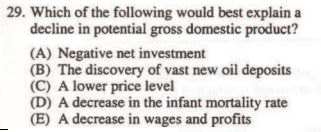
Answer (A) Negative net investment.

Answer (D) household production

Answer (A) not change, because there is no change in total expenditures.

2005
Answer (C) is adjusted for price level changes using a price index.

Answer (E) savings

Answer #34 (E) additions to business inventories
Answer #35 (C) 6%

Answer (C) Recipients of transfer payments have not produced or supplied goods & services in exchange for these payments.


2008

Answer (B) Nominal national income

Answer (C) 5%

Answer (D) Foreign companies build new assembly plants in the US

Answer (C) net exports were negative

Answer (E) a newly constructed home.