Thursday, April 9, 2020

ALL Lump Sum/ Per Unit FRQ

Lump Sum/ Per Unit FRQ

2015 AP Microeconomics Exam

1. 

(D.) If the market is in LR Equilibrium, and the government gives a lump sum subsidy, what will happen to the following.

(i) The firms quantity in the short-run. Explain.

If the Market/Industry is given a Lump-Sum (Subsidy or Tax)
then the Lump Sum does not effect the Marginal Cost Curve of the Firm
therefore
the quantity of the firm doesn't change.

(ii) The market price and quantity in the Long-Run. Explain.

If firms are in LR Equilibrium and a Lump Sum subsidy is given 
then firms will be making Positive Economic Profits
Positive Economic Profits attracts firms (Firms Enter)
Supply Increases Price Decreases and Quantity Increases


2012 AP Microeconomics Exam

1. Steverail (Monopoly) is incurring economic losses
(A.) 

(C.) Assume a per unit subsidy to Steverail.

(i) Will Steve quantity increase, decrease, or not change? Explain.

Per Unit subsidies effect the MC curve (shifts right)
Understand that the MC curve is the firms supply curve
If the firm is given a subsidy for every unit of production then the Supply shifts right
the MC shifts right then the Price Decreases and Quantity increases

(ii) What about Consumer Surplus?

The Price decreases and therefore
CS will Increase


(D.) Assume that a Lump-Sum Subsidy is provided.

(i) Will the DWL, increase, decrease or stay the same? Explain.

Lump Sums do not effect the MC curve
therefore quantity can't change
therefore DWL can't decrease
as the only way to decrease DWL is to increase quantity

(ii) Will Steverail losses increase, decrease or remain the same.

Subsidies would decrease Steve's losses


2011 AP Microeconomics Exam
(A.) 

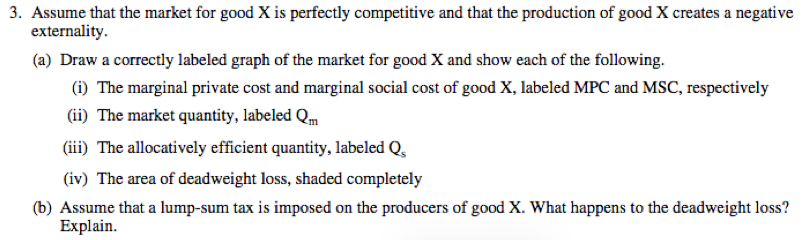
(B.) Assume a Lump-Sum. What happens to the DWL? Explain.

If a lump-sum tax is imposed it doesn't effect the MC curve
therefore quantity can't change therefore DWL can't change.

2009 AP Microeconomics Exam

(A.)

(B.) Assume lump-sum subsidy will quantity change? Explain.

NO, as Lump-Sum subsidies do not effect the MC curve 
therefore quantity cannot change.


2008 AP Microeconomics Exam

(A.) 

(B.) Now assume a lump-sum subsidy is given, effect of the following in the short-run.

(i) Callahan's quantity of output. Explain.
As the Lump-Sum subsidies do not effect the MC curve
therefore Quantity doesn't change.

(ii) Callahan's profit - Increases as monies are being given.

(iii) The number of firms in the industry.

No firms can enter in the short-run.
Tricky Bastards

2007 AP Microeconomics Exam

1. Patent = Monopoly

(A.) GCR is making a profit

(B.) Assume the government gives a lump sum tax. 
(i) Output and Price? Explain.

Lump-Sum taxes do not effect the MC curve
therefore quantity and price do not change.

(ii) What happens to GCR's profits?
GCR's profits decrease as they are taxed.


(C.) Assume instead the government gives a per-unit subsidy.
(i) Output & Price? Explain.

Per-Unit Subsidies shift the MC curve, 
a per-unit subsidy would shift the MC curve to the right
price would decrease and quantity would increase

(ii) What will happen to GCR profits.

Profits increase as the more produced the more subsidy given.


2000 AP Microeconomics Exam

(G.) To achieve allocative efficiency what would be best a per-unit tax or per-unit subsidy.

A per-unit tax would shift the MC curve to the left, quantity would be reduced
and therefore DWL is larger as we are further away from allocative efficiency.

A per-unit subsidy would shift the MC curve to the right, quantity would increase
and therefore DWL would decrease as more quantity will be produced, 
as we are moving closer to the SOQ the we are becoming more
allocatively efficient


Wednesday, April 8, 2020

ALL (Fiscal Policy) Multipliers FRQ's

All Multipliers (Fiscal Policy) FRQ's
Multiplier Cheat Sheet here

2019 AP Macroeconomics Exam

(A.) Draw a AD/AS curve showing Recession

(C.) The MPC = .8. The equilibrium (current) output is $500b and the Full-Employment output is $540b.
(i) Calculate the minimum change and the direction of change in taxes required to get the AD to close the output gap.

If the MPC = .8
the MPS = .2
GS multiplier is 1/MPS or 1/1-MPC
1/.2 = 5 is the GS Multiplier
to get 40b of GDP then GS needs to increase by 8b (40b/5 = 8b)

(ii) Calculate the minimum change and the direction of change in the required to get the AD to close the output gap.

The Taxing Multiplier formula is MPC/MPS if taxes are decreasing (expansionary)
the Taxing multiplier if taxes are decreasing is -MPC/MPS

the quick understanding is that the Taxing Multiplier is
always 1 Less than the GS Multiplier

I'll say that again

**The Taxing Multiplier is always 1Less than the Gs Multiplier**

If the GS multiplier is 5 then the Taxing Multiplier is 4
IF taxes are reduces the amount of reduction in taxes needs to be greater to 10b.

40b/4 = 10b of reduced taxes
Why is the taxing multiplier less???

If the GS increases all of that money immediately flows out into the economy
increasing consumption and shifting AD right.

If citizens get a tax cut then some of it will be saved. Not all of the tax savings is spent so
taxes have to be cut by a greater amount than GS to ensure the AD increase.


2015 AP Macroeconomics Exam

1. Operating below full employment = Recession
(A.) Draw a CLG of the AD/AS curve showing a recession.

(D.) Assume using fiscal policy the MPC is .8 and the value of the recessionary gap is 300b.

(i) If the government changes its spending without changing taxes calculate the minimum needed to close the output gap.

We need 300b of an increase in GDP the MPC is .8 therefore the MPS is .2
the GS multiplier is 1/MPS = 5
The GS needs to increase by 60b
as 60b X 5 = 300b of GDP increase

(ii) If the government decided to reduce taxes to close the output gap then,

The Taxing multiplier formula is MPC/MPS = 4
or
You should just know that the taxing multiplier is always 1 Less than the GS Multiplier

300b/4 = 75
The government would reduce taxes by 75b X 4 = 300b of GDP increase
75 > 60


2014 AP Macroeconomics Exam
1. The economy is below full employment = Recession

(C.) If the MPC is .75 and the government spends 100b what is the maximum change in GDP.

If the MPC = .75 then the MPS = .25

the GS multiplier = 1/MPS = 4

GS 100b x 4 = 400b of GDP increase


(F.) The government pays for the 100b of GS by increasing taxes by 100b,,,
what will happen to GDP.

If you use Expansionary (Fiscal) Policy GS increases by 100b = 400b increase GDP
at the same time
Contractionary (Fiscal) Policy with Taxes increasing by 100b = 300b decrease GDP
Why 300b (because the Taxing multiplier is 1 LESS than the GS multiplier (3)

((400b increase and 300b decrease still leaves an increase in GDP of 100b))


2008 AP Macroeconomics Exam

1. Drop in consumer confidence decreases C - consumption therefore the economy is now in a recession.

(C.) The economy is short 500b and the MPC = .08

(i) What is the minimum of GS to close the gap

If the MPC = .8 then the MPS = .2
the GS multiplier = 5 as 1/MPS = 5

If the government spends 100b x (5) = 500b GDP increase

(ii) Instead the Government wants to reduce taxes to close the gap. U.

The Taxing multiplier = MPC/MPS = 4
the government must reduce taxes by 125b to increase GDP by 500b
as 125 x 4 = 500b increase in GDP

2000 AP Macroeconomics Exam

(B.) Government spending has the greater multiplier so gets the biggest kick to GDP.


Tuesday, April 7, 2020

ALL Demand for Money (DM) FRQ

ALL Demand for Money (DM) FRQ

Demand for Money Cheat Sheet here.


2017 AP Macroeconomics Exam
If consumers wish to hold less money because the fees on credit cards have been lowered
the DM curve will shift to the left
the NIR will decrease.

2010 AP Macroeconomics Exam
If consumers wish to hold less money because the fees on credit cards have been lowered
the DM curve will shift to the left
the NIR will decrease.

2007 AP Macroeconomics Exam
If people are worried about the state of the world, the stock market, they will tend to take money
out of anything risky (stock market) and hold the cash for mainly two reasons
1) to keep the value of their holdings from decreasing
2) If things are bad people naturally want to hold cash for emergencies


2007B AP Macroeconomics Exam
(A.) Australia begins to recover from their recession, what happens to New Zealand's AD/AS.
If Australia begins to recover they will buy more exports from New Zealand
exports increasing increases New Zealand's AD curve
(B.) Use a Money Market graph to explain what happens to New Zealand's 
(i) Demand for Money. Explain.
(ii) NIR
As New Zealand's AD increases the PL also increases
PL increasing drives up people's demand for Money (DM)
which drives up the NIR


(C.) The PL in New Zealand increases what happens to the Real interest rate.

As the PL increases the Real Interest Rate falls
but
an increasing NIR implies that the RIR is also increasing
RIR is indeterminate