Aggregate Supply (AS): is defined as the planned level of output that domestic firms are willing to offer at different average price levels per period of time.
Short-run aggregate supply (SRAS) - the period of time in which money (nominal) wages are assumed fixed over the short-run and unable to adjust to changes in the average price level.
Why, fixed?
1) Contracts cannot be broken.
2) Workers are slow, unaware of price level increases/decreases and therefore are slow to recognize their purchasing power has been affected.
SRAS Curve
Upward sloping as Price Levels (PL)'s rise, firms enjoy larger profits and therefore produce more.
Shifting of the SRAS Curve: Right
Causes of the shift right of the SRAS curve: (decrease in production costs)
Decrease in wages (not in the SR)
Increase in physical capital stock
Increase in technology
Increase in subsidies
Decrease in business taxes
Expectations that the price level will decrease
1) Price Level: decrease
2) GDP: increase
3) Unemployment: decrease
Shifting of the SRAS Curve: Left
Causes of the shift left of the SRAS curve: (increase in production costs)
Answer (C) - wages are a cost of production. Lower wages and aggregate supply will shift right. (A) an increase in interest rates will increase the costs of production, (leftward shift of SRAS) (B) increasing taxes would increase production costs (shifting SRAS left) (D) mandates on pollution increases production costs (leftward shift) (E) shutdown and movement of goods equals higher production costs. (left shift) 2000 AP Macroeconomic Exam
Answer (A) an increase in productive resources will shift the SRAS curve to the left. (B) Productivity increases lower production costs and therefore would shift the SRAS right. (C) Increases in the money supply would lower interest rates and shift AD right. (D) A budget deficit implies that money is being spent, a rightward shift of AD. (E) Imports increasing means that exports relatively are decreasing, AD shifts left. 2005 AP Macroeconomic Exam
Answer (C) III the cost of all inputs (production costs)
Aggregate Demand & Supply Cheat Sheet (Need a bigger copy of the below? E-mail wcwaugh@aol.com) Tentative,, AP FRQ Cheat sheet. It is very clear that the bulk of recent past exams have been moving from equilibrium/ recession to recession/recession-LR. Still, knowing that in the short-run, the SRAS curve (usually) does not shift and so a movement during this time usually starts with fiscal policy actions (government spending) that increases AD to push the economy back to equilibrium. Get familiar with the terminology of how the College board asks these questions (triggers), you must understand all of these graphs!!!! I'll write that again, in the short-run (For the AP) the SRAS (usually) does not shift,, only AD. (As some questions are stand alone questions this rule is for questions that usually involve starting the economy in equilibrium or recession,, moving into recession and then the government refraining from action. Over time prices and wages adjust, a shifting of the SRAS) In the Long-Run , SRAS shifts moving the economy back to equilibrium.
Let me see if I can be a bit more clear. The SRAS curve obviously can shift in the Short-Run as it does when Negative supply shocks occur 2004B & 2006(Stagflation) or when Positive supply shocks occur (Economic Growth) or when the government decides to lower business taxes(2004B) to offset the effects of Stagflation. (think, Keynesianism)
The difference being that SRAS shifts on its own in the long-run to offset happenings in the economy. If the economy has been experiencing inflation (rising production costs) the firm will (in the long-run) begin to reduce employment and output, while passing higher costs onto consumers as higher prices. The economy will return to equilibrium (with higher PL's),, the point to be taken away is that in the LR the economy will be self correcting with a shifting of the SRAS curve. (think classical/monetarists economists and flexible prices & wages).
I have found no Circular flow FRQ's but definitely in the multiple choice section of the exam. Anyone know of anything different then please e-mail me. wcwaugh@aol.com.
Welker Video: The Circular Flow Model
Pajholden video: Circular Flow of Income:
Above is a simple model of the Circular flow.
1995 AP Exam
Answer (D)
2000 AP Exam
Answer (D) Households demand products produced by firms, yet at the same time, they supply their resources (labor) to firms.
Leakages & Injections
Leakages include: savings, taxes & imports
Injections include: investment , government purchases & exports
If Injections > Leakages = GDP growth (higher output)
If Leakages > Injections = GDP slow (less output)
Answer (E) Savings
Paradox of Thrift Video - This touches on the reason savings (even though it gets deposited into banks to be invested) is considered a leakage. More to come on this subject.
Nominal GDP: is GDP not adjusted for inflation and is measured with current prices. Real GDP: is GDP adjusted for inflation. Inflation: is a sustained increase in the general price level. Deflation: is a sustained decrease in the general price level. The problem is in coming up with good figures for GDP we have to be able to use values (prices) for all goods and services (output) produced in that year.
But, if there is a 10% rise in prices (inflation) then GDP will appear to have grown by 10% when in actuality no increase in production happened.
Ex. In 2000 Apples produced (Output)10 and the (price) is $1 each, then GDP = $10
but in 2001 Apples produced (Output) 10 and the (price) is $2 each, then GDP = $20 a doubling of GDP, But there hasn't been an increase in production (output) just an increase in prices (inflation).
So, the fix to allow comparisons over time, GDP has to be measured in real terms, where GDP is adjusted for inflation. We do this by using what is called the GDP deflator. GDP Deflator or Price Deflator: is like a price index in that it measures price inflation/deflation with respect to a specific base year.
Knowing just this,, lets us do an AP problem:
2005 AP Macroeconomic Exam:
Answer (C) is adjusted for price-level changes using a price index.
So, lets say it again.
Nominal GDP is a measure of output valued at present prices.
Real GDP is a measure of output valued in prices of a base year
Lets find the real GDP using some numbers.
EX. 2014 basket of goods:
2015 basket of goods:
What we see is that the Nominal GDP (Output X Current Prices) for 2014 is $52 and in 2015 nominal GDP is $70.
But what if we want to find the Real GDP for 2015,,,we can use 2014 as the base year. This means we use the Output of 2015 with the Prices of 2014.
So, if we look at the two charts above we can see that overall 2015 had less output but prices increased.
Real GDP for 2015 is $46,,
The GDP Deflator is a price index that can be used to adjust a nations nominal GDP for changes in the Price level.
Formula for finding the GDP Deflator is
Remembering that the base year 2014 always equals 100 since in that year Real GDP = Nominal GDP.
The GDP deflator = Nominal GDP/ Real GDP
So, using the information in the tables above Nominal GDP 2015 is 70/ Real GDP 2015 is 46
Therefore, the deflator is 70/46 = 1.52 or we can say that prices (inflation) have risen by 52%.
*If the deflator had been 95 then prices would have said to have fallen by 5%. 1995 AP Macroeconomics
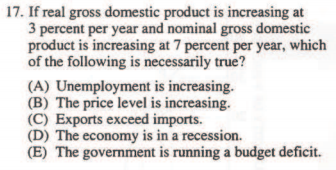
Answer (B) 7% If Real GDP is Nominal GDP minus inflation then 11-4 = 7%.
Answer (B) If real GDP is nominal minus inflation then 7-3 = 4% inflation, thus rising prices. 2011 B, Question #3 FRQ
A) (i) Nominal GDP for 2010 is simply (output) X (price) for 2010. So, (8x2.5 = 20) + (10x10 = 100) + (5x5 = 25) = $145 (ii) Real GDP for 2010: is 2010(output) X 2009(prices) or 20 + 60 + 20 = $100 B) This problem always seems to cause some confusion but it's quite simple and once you understand it you on't ever miss another one like this. 1) The increase from one year to the next is 5 (55-50 = 5) & 5 is a 10% increase from the base year. (50/5 = 10%) 2) I would just double the numbers to get a closer understanding to what I'm use to. So, 50 doubled is 100 and 55 doubled is 110,, therefore the rate of inflation was 10%. C) If real wages only increase by 3% but inflation increases by 4%. If your real wage is $100 and it went up by 3% to $103 and everything you need to live is paid for out of that $103 dollars, (rent food and clothing). Now, due to inflation, rent, clothing and food will cost you $104 due to the rise in prices(inflation). Your real wage will be lower (worth less) due to inflation. Another way to think about this is that your purchasing power would have shrank due to the inflation. D) If Sara gets a loan and the expectation is that inflation will be 3% but the inflation rate is actually 4%. Then Sara will have borrowed money at a rate that is less than actual inflation. She will benefit and the bank will not benefit. It (the bank)will be repaid in dollars that can now buy less than when they were loaned. If you loan $100 to Joe and Joe promises to repay you 101 dollars at the end of the year. You have wanted to buy a Stereo that costs $101 dollars. You will be making a simple interest rate loan of 1%, but at the end of the year inflation has increased by 5% then you will find that the stereo has increased in price to $105 (yea I know the math isn't right,, bear with) and you only get $101 back from Joe. You, my dear friend, have incorrectly predicted the rate of inflation and loaned your money to Joe to cheaply,, you have lost money as the cost of the stereo is further from your grasp than when you initially loaned out the money to Joe. Inflation harms creditors and helps debtors and deflation helps creditors and harms debtors.
“…the welfare of a nation can, therefore, scarcely be inferred
from a measure of national income…”
Simon
Kuznet, 1934, designer of the
GDP
GDP - defined as the value of all final goods and services produced within an economy over a certain period of time, usually a year.
Mjmfoodie - GDP video
3 ways to arrive at the GDP figures.
Output Approach: whereby production (output) is summed across all industries over a period of time. Ex. Primary sector + secondary sector + tertiary sector = GDP
Income Approach: provides information about the proportion of total income earned by laborers in contrast to owners of capital. Ex. wages + profits + interest + rents = GDP
Expenditure Approach: permits us to monitor the level of investment spending through time or the proportion of government expenditures in total economic activity. Ex. C + I + G + X-m = GDP
AP is mainly concerned with the Expenditure Approach.
Components of GDP (Expenditure Approach)
C = Household (personal) consumption: durable consumer goods, non-durable consumer goods & consumer expenditures for services (think, any final goods purchased)
I = Private domestic investment: all final purchases of capital business & all construction (households included) (think, purchases, construction or adding to inventories by business and construction by households)
G = Government Purchases: (all government spending on products, resources & services)
Xn = Net Exports: (exports - imports)
Some things are not counted in the GDP figures:
Public transfer payments: (social security, welfare, etc) - no goods or services are provided.
Private transfer payments: (monetary gifts, alimony, etc) - nothing is produced
Security transactions: (buying and selling of stocks,bonds, etc) But: (brokers fees and commissions are included in GDP)
Secondhand Sales: (any used goods) - don't reflect current production, as they were counted when they were originally sold.
Goods produced outside of the US are not included in GDP (look at the definition)
The GDP figure tries not to Double Count - if we were to count the prices of intermediate goods (goods used to make final goods, ex. the price of steel and then the price of the car, we would be double counting the price of the steel, as its value is included in the final price of the new car sale) instead of final goods in the Expenditure Approach, since the value of the final goods include the intermediate goods, it would constitute a counting of the same thing multiple times, making GDP higher than it really is.
AP 2000 Macroeconomics Exam
Answer (C) The government increases its domestic purchases of food for use by the military.
(A) is not correct as Security Transactions (purchase of stock) is just a transfer of ownership, nothing has been produced.
(B) is not correct as GDP is goods that have been produced within the domestic economy.
(D) is not correct as GDP is current year production of goods and services.
(E) is not correct as GDP does not include secondhand sales.
Gross Domestic Product (GDP): is the tally of all money spent
by individuals, households, business and government usually in a year.GDP attempts to measure the size of an
economy and is used as a comparison between countries. It also inherently
implies that a growing GDP is indicative of a country that is increasing its
well-being.
There are some problems with using the GDP figure:
1. GDP treats goods and services as homogenous
GDP ultimately cannot tell us if spending has been for real wealth
creation or capital consumption.
2.If you marry your maid, you lower GDP -GDP
fails to take into effect the underground economy, bartering, volunteer
services, and child-rearing, do-it-yourself improvements. A higher well-being
might be achieved without expenditures and therefore not translate into a
higher GDP.
3.Burn Paris and you make GDP grow -GDP
only includes positive values. This has led to all types of politicians,
newscasters and economists (who should know better) to state that natural
disasters will benefit a country because rebuilding will stimulate production.
See (Broken Window Fallacy) below.
4.GDP is insensitive to distribution of income. -A
country may be oil rich and have small ruling elites, a large population of
poor and have a high GDP. A country with a comparable GDP might have a thriving
economy with much lower income inequality.
5.“If the government decides to build a pyramid
and spends a trillion dollars then GDP will rise by a trillion dollars”.
-The
inclusion of government spending in GDP implies that all government spending
must increase the welfare of its people. Thus pyramid building, wars, ever
growing government increases GDP but does not necessarily increase welfare. The
comparisons between private spending and government spending are confused by a
failure to understand that government spending must be funded by forced taxation
or monetary printing. AP 2005 Macroeconomic Exam
Answer (E) Additions to business inventories. (produced within a country) not sold. (A) government transfer payments are not added to GDP, as nothing is produced (B) Purchases of used goods are not included as second hand sales are not added to GDP. (C) Childcare by househusband, not included (shortcomings of GDP) (D) Total value of business inventories, (produced this year & some inventories are intermediate goods.)
Market behavior really is motivated largely by the same desire that transformed Scrooge on Christmas morning—the desire to help those who mean the most to us—and that motivation, when directed by the mundane morality of markets, results in our also serving the interests of multitudes of people we will never know. By emphasizing that a good economy, like a good life, is best achieved by the mundane morality of markets coupled with recognition of the motivational importance of magnanimous morality, economists would make a case for the morality of markets that has some of the same emotional appeal as does the transformation of Scrooge in A Christmas Carol.
And the economists, oh, the economists, how they counted, and still count. Take up any copy of The American Economic Review to hand (surely you subscribe?) and open it at random. To perhaps Joel Waldfogel, "The Deadweight Loss of Christmas" (no kidding: December 1993; Waldfogel is arguing that since a gift is not chosen by the recipient it is not worth what the giver spent, which leads to a loss compared with merely sending cash. Who could not love such a science of Prudence?
I just finished this but will work more on it later next week. All the pieces are added but just not quite right. Remember to do all the Multiple choice and the FRQ's before the exam. Questions, comments,, wcwaugh@aol.com.