Tuesday, March 10, 2015

2010 Multiple Choice Questions (FED, Banking, Monetary Policy & Money Creation)

2010 Multiple Choice Questions (FED, Banking, Monetary Policy & Money Creation)

This section, along with AD/AS is the second most tested.
Here are the multiple choice questions for the 2010, AP Macroeconomics exam.

Notice, topics questioned include: 
T-accounts, Velocity of Money, Bond Prices, Res. Requirements, Rational Expectations

*(the FRQ's for this section are quite easy compared to the wealth of knowledge you need to be able to answer the Multiple choice)


Answer (A) Reduce Inflation

 Answer (A) increase in the nominal output

 Answer (C) Interest rates will decline

Answer (C) increasing the reserve requirements

Answer (C) selling bonds on the open market

Answer (B) Rational Expectations

Answer (B) demand deposits

Answer (D) Engage in Open Market Purchases

Answer (B) It falls when interest rates rise, because the opportunity cost of holding money increases.

Answer (B) Increase - Decrease

Answer (D) Decrease - Decrease

Answer (E) Buying Bonds increases the MS, which lowers the interest rate
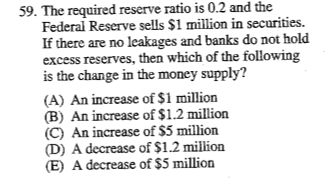
Answer (E) a decrease of $5 million


Monday, March 9, 2015

Monetary Policy (Money Supply) FRQ Cheat Sheet

Money Supply & The FED (Monetary Policy)

Here is a FRQ cheat sheet for Monetary Policy (money supply) and soon I will add a cheat sheet for this section of the AP Macroeconomics exam.


Notice we can see some trends:

Demand for Money 

  • Increases or decreases based on people's desire to hold more or less currency (Cash)
  • Incomes change (Income Increases, (C) Increases, (I) increases, (AD) Increases, Output increases, therefore DM Increases)
  • Income change (Income Decreases, (C) Decreases, (I) Decreases, (AD) Decreases, Output Decreases, therefore DM Decreases)
  • Show how this effects nominal interest rates and the price level.
  • How the FED can counteract the effects.
    Money Supply
  • What is the open market operation the FED will use? Expansionary(Buy bonds)
  • What is the open market operation the FED will use? Contractionary (Sell bonds)
  • Show what happens to the Nominal Interest Rate.
  • What happens to the Price Level and the Real Interest Rate?
  • What happens to Aggregate Demand (AD)?


Tuesday, March 3, 2015

AIS Market Failure Lesson #2

AIS Market Failure Lesson #2


Lesson 2: Externalities
Negative Production Externality
Positive Production Externality
Impact & Solution
Problem


Homework (Watch Videos & do the 2011B FRQ #2)
Welker - video
·      Market Failure – Negative Externality of Consumption


·      Market Failure – Positive Externality of Consumption


Waugh –  DUE Thursday 2011B FRQ #2 (Complete and have in class on Thursday)
AP Central - FRQ - 2011B FRQ #2

AP Central - FRQ - Answer - 2011B FRQ #2 Answer


AIS Resource Costs (Labor) Lesson #2


    AIS Resource Costs (Labor) Lesson #2

     mjmfoodie - video
ACDC - video
Monopsony  (Monopoly in the labor market)


    Reffonomics  - website - link (Do look at this link!!!)
    MRP = MRC
   

   AP Central FRQ Questions 1-3 (Bring to class,, completed)
    2008B FRQ#3
   AP Central Answer to 2008B FRQ#3
   ACDC - Video - on 2008B FRQ#3 


Saturday, February 28, 2015

AIS Resource Costs (Labor) Lesson 1

AIS (Labor) Lesson 1

mjmfoodie - Perfectly Competitive Factor & Output Market
ACDC - Videos

  • 5.2 Perfectly Competitive Labor Markets


  • 5.3 Comparing Product & Resource Markets


  • 5.4 Resource Market MRP = MRC


Reffonomics - Website


AIS Market Failure Lesson 1

AIS Market Failure  Lesson 1


Market Failure - Introduction

1) mjmfoodie - market failure episode 31


2) welker - Intro to Market Failure - Negative Externality


3) ACDC - Market Failure - Micro 6.2

4) ACDC - Externalities - Micro 6.3

5) mjmfoodie - Episode 32


6) Mike Munger - When is a potato chip not a potato chip?

7) Reffonomics - website


8) AP Central - Problem

9) AP Central  - Answer

Wednesday, February 18, 2015