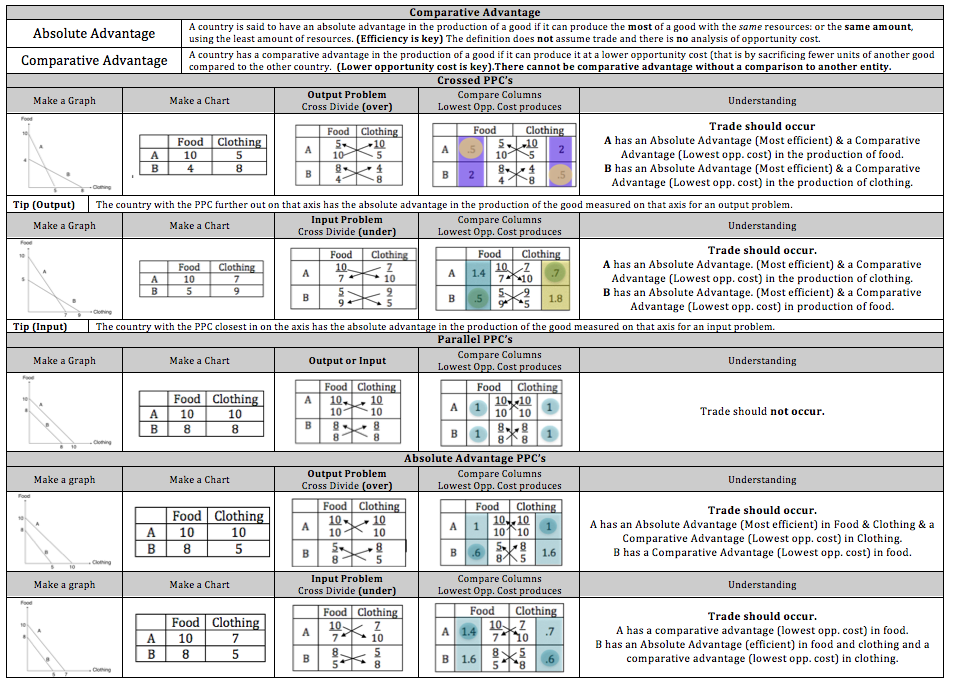
Comparative Advantage Cheat Sheet
Tentative Comparative Advantage Cheat Sheet,
See a mistake,, comments, corrections,, e-mail wcwaugh@aol.com.
Sunday, May 10, 2015
Sunday, May 3, 2015
Profits Cheat Sheet
Profits Cheat Sheet
Much confusion with the differing ways to show accounting and economic profit for the AP FRQ's.
All of these different ways were asked at some point on past FRQ's.
Added some numbers to see if I could make it more clear.
All of these different ways were asked at some point on past FRQ's.
Added some numbers to see if I could make it more clear.
Thursday, April 30, 2015
Monopolistic Competition Cheat Sheet
Monopolistic Competition MJMfoodie Video
Monopolistic Competition Jason Welker Video
Tuesday, April 28, 2015
Monday, April 27, 2015
2011 AP Microeconomics FRQ #3
Watch me answer it here
(b) Assume that a lump-sum tax is imposed on the producers of good x. What happens to the deadweight loss. Explain.
Dead weight loss is inefficiency,, in that someone (Third party) is being harmed and is not being compensated. The government steps in and (theoretically) taxes the producers causing them to internalise the cost of the externality. In theory, the costs of the producer increases and production decreases.
A lump-sum tax is viewed by producers as a fixed cost,, a cost of doing business with no connection to output. Fixed costs have to be paid if you produce or not. So, a lump-sum tax will not change or affect the variable costs (marginal costs) of a producer. Therefore, the firm who pays a lump-sum tax will not alter its amount of production. There will be no change in quantity produced and therefore would be ineffective as an incentive to get a producer to internalise the cost and produce less quantity of the negative externality.
IF marginal costs do not shift then the firm will stay at that profit max quantity.
Answer - One point is earned for stating that the deadweight loss does not change because marginal cost
does not change.
Saturday, April 25, 2015
Friday, April 24, 2015
2011 AP Microeconomics Exam FRQ #2
2. Assume (perfectly competitive). Typical firm is earning positive economic profit in the short-run.
(a) Draw a CLG for the typical firm.
Watch me answer it here
(a) Draw a CLG for the typical firm.
Answer
One point is earned for a correctly labeled graph with a horizontal demand curve at the equilibrium price, PE.
One point is earned for showing the equilibrium quantity, QE, at MR = MC.
One point is earned for showing that ATC is below demand or MR at Q.
(b) Assume there is an increase in the market wage rate for labor, variable input. Show on your graph in part (a) the effect of the wage increase on the marginal cost curve in the short run.
The MC curve shifts left,,, (MC, think VC or wages)
(c) Assume the avocado producers hire labor from a perfect competitive labor market. Draw a graph of the labor supply and demand for a typical firm and label the supply curve MFC and the demand curve MRP. Assume the market wage rate increases form w1 to w2. Show the effect of a wage increase on the graph, the initial quantity of laboured hired at QL1 and the new quantity of labor at QL2.
Since the firm can hire its labor in a perfectly competitive labor market, the wage rate is determined by the market rate and it is a horizontal line. (They can hire all they want at that price)
Answer - One point is earned for drawing a correctly labeled graph with a horizontal MFC1 curve at w1 and a downward-sloping MRP curve and showing QL1. One point is earned for shifting the MFC curve up to w2 and showing the new equilibrium quantity of labor hired, QL2, which is smaller than QL1.
Subscribe to:
Posts (Atom)