2002 AP Macro Exam (Form B)

Good question for the College Board.
Watch me answer it here,


Answer - Investment is a component of aggregate demand, so when investment decreases, AD decreases (shifts left) as indicated on the graph above. This decreases output from Y to Y', and the price level falls from PL to PL'.

(b) Using
the results in part (a), explain how employment is affected.
When private
investment decreases then Aggregate Demand (AD) shifts leftward which means
that output decreases and therefore employment decreases.
Answer - Employment rises and falls with the (real) output level. In this case employment will decrease because
output decreases.
(c) Identify
one specific fiscal policy that might be implemented to offset the decrease in
investment, and explain how the policy would affect each of the following in
the short run.
(i) Aggregate Demand
(ii) Output & Price Level
(iii) Real Interest Rates
One fiscal
policy that could be implemented would be an increase in government spending
(Gs), in the short run an increase in government spending would increase
aggregate demand (AD), output and the price level & real interest rates
would also increase.
(Notice that they have in the short-run) because in the long-run Government spending will decrease aggregate demand due to rising real interest rates. As Keynes said, we are all dead in the long-run and therefore we sacrifice long run investment (capital formation) to gain short term boosts in aggregate demand.) This is asked about a lot,, know it...
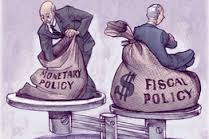
From the Fiscal Policy cheat sheet.

Answer - To off set the effects of the decrease in investment, the government could increase its expenditures (G) or
decrease taxes. With an increase in Gs, AD will increase since G is a component of AD. The increase in
AD will increase output and the price level. Increases in government borrowing in the loanable funds market
will increase the interest rate, as will increases in the demand for money resulting from increases in income.
(d) Identify an open market operation that
the central bank might implement to offset the effects of the decrease in
investment, and explain how the policy would affect each of the following in
the short run.
(i) Real Interest Rates
(ii) Aggregate Demand
(iii) Output and the Price Level
One Monetary policy would be to buy bonds, thus injecting cash into the economy.
From the Monetary Cheat Sheet.

Answer - The central bank could buy government bonds to increase the money supply. The increase in the money
supply will cause real interest rates to fall. AD will increase because investment and interest-sensitive
consumption will both increase, and both investment and consumption are components of AD. The increase
in AD will cause the price level and output to increase.
(e) If the central bank continues the open market operation described in (d) , explain the long-run effects on each of the following.
(i) Inflation
(ii) The value of the currency in the foreign exchange market (FOREX).
If the Price level (PL) is increasing then inflation is increasing as they are the same thing.

Careful,, College Board is being tricky.
If the FED (Central Bank) is increasing the money supply then the value of the currency is decreasing as our goods are going up in price (PL increasing) and therefore our goods look relatively more expensive compared to foreign goods prices therefore there is less demand for our goods and less demand for our currency in the FOREX. Less demand = value decreases.
Also lower interest rates caused by an increase in the money supply will reduce capital flows as investors are looking for higher rates of interest rates than their own. At the margin with lower interest rates there will be less demand for our currency to invest in our interest bearing assets. Less demand less value.
Answer - If the central bank continues to increase the money supply, the price level will continue to increase as
explained in part (d), resulting in an increase in inflation. The higher price level and lower interest rate that
result from an increase in the money supply will make domestic prices and interest rates relatively
unattractive. The domestic currency will be exchanged for foreign currency by those wishing to purchase
goods and invest capital elsewhere, and less domestic currency will be demanded by foreigners, causing a
devaluation of the domestic currency in foreign exchange markets.

College Board give me my 5