Thursday, January 12, 2017

2012 Multiple Choice - (Perfect Competition)

2012 Multiple Choice - (Perfect Competition)

I want to believe in Perfect Competition.


Answer - (C) I and IV

Understand that the firm above/below is making profits.
P > ATC = Positive Economic Profits
In the Long-Run Firms enter the industry hunting for profits.
SSSHHHH... I'm hunting for Pwofits.


Answer - (D) Perfectly Competitive Q3

Recognise that the perfectly competitive's firms Total Revenue Curve is upward sloping
and continuous as they can sell all they want at the market price.
Understand that at the quantity where TC is furthest away from TR on the graph is Profit max.

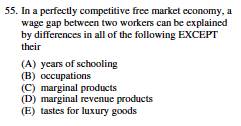

Answer - (E) tastes for luxury goods

WTF!!!!

(A) years of schooling (YES) different wages due to different human capital
(B) Occupations (YES) Obviously the doctor receives more than the bus driver
(C) Marginal Product (S) of workers (YES) workers can be paid different wages based on MP,, at some point someone gets paid a salary of zero, as they aren't hired... 
Yes,, that is a weak explanation..
(D) Marginal Revenue Products (Yes) possibly different firms, different salaries, as the MRP is MP * P (price of the good) so a higher price could lead to larger wages as firms try and hire enough labor to  meet the quantity demanded.
(E) Tastes for Luxury Goods (NO) Someone's desire for luxury goods does not change the wages between workers.


2012 Multiple Choice - (Gini Coefficient/ Progressive Taxation)

2012 Multiple Choice - (Gini Coefficient/ Progressive Taxation)


Welker - Video


Answer - (B) More progressive income tax

Understand that incomes are earned,, distribution is what the government does so in actuality wealth is distributed not incomes.

If someone steals from me their wealth might have increased 
but to call that income is offensive.

Answer - (E)

This a simple recognition problem. Understand that they don't want you to calculate the percentage differences between the before/after incomes.

These gini coefficient and progressive tax questions are mostly recognition questions.

I hate these questions...

2012 Multiple Choice Government Intervention (Price floors, ceilings, indirect tax)

2012 Multiple Choice Government Intervention (Price floors, ceilings, indirect tax)
Government Intervention cheat sheet here.


Answer - (B) A shortage of 6 billion gallons

Understand, that the biggest problems with these problems is knowing a ceiling from a floor.
say it,,,,,
Floors are high
Ceilings are low
say it again,,,,
Floors are high
Ceilings are low 

You might be tempted to say that the shortage is 4 billion gallons but understand that at the new (government controlled) price the Qd increases to 12b.
12b(Qd) - 6b(Qs) = 6b actually supplied


Answer - (D) Decrease   Decrease


Answer - (B) create a shortage of flashlights

If demand increases but supply does not, then shortages occur.
Producers will only supply more of a good if the price of the good increases


The NET price is the price received with the taxes taken out 
(amount the seller gets to put in his pocket)

18) Answer (D)
19) Answer (D)


Government Intervention Cheat Sheet Updated (01/12/2017)

Government Intervention Cheat Sheet Updated (01/12/2017)
Price Ceilings
Price Floors
Indirect Tax/Subsidy
Tariffs


2012 Oligopoly Multiple Choice

2012 Oligopoly Multiple Choice
Oligopoly Cheat Sheet here.

Answer - (A) Oligopoly

Understand that the word interdependence = oligopoly 


Answer - (C) A few competing sellers with similar products and high barriers to entry.

Recognise the definition of oligopoly?


Answer - (B) Both companies have an incentive to reduce production by 10%.

For the love of Pete, make a chart.
answer the chart.

Now, you know what they should do depending on the other (firms) actions,

but if they don't cooperate they don't know the other (firms) actions,

so, they don't cooperate.

Let us look at the answers 1 by 1


(A) Neither Company has a dominate strategy.
Actually both companies have dominate strategies UB (-10%) & UA (-20%)
Dominate Strategy - Best choice no matter the choice of the other participant. Doing the same thing no matter what the other firm does, is a dominate strategy.

Answer - (B) Both companies have an incentive to reduce production by 10%.
(B) is answered in the answer to (C), below


(C) Both companies have an incentive to reduce production by 20%
On first glance, this seems appropriate.
If they are both choosing to reduce by 20% then the payoffs would be $150 each, not bad.
but
this would only be true if they both new the information in the matrix
they don't
The problem says, based on the information, and assuming no cooperation,
assuming no cooperation implies they don't have information about the payoff matrix
so, if they don't know the information in the payoff matrix
they are going to choose the quadrant where they make the most money.

They do have the incentive of -20%, if they are cooperating
but they aren't cooperating.
The greedy principle....

Without knowing the information in the payoff matrix, they each choose the highest payoff
why not????

Because they both made the rational choice, highest payoff & didn't cooperate

they end up, making the least amount on the board.

(B) If the question had asked what the payoff would have been with no cooperation it
would have been 
UA chooses -10% and receives  $100
UB chooses -10% and receives  $100
This was the question and is the answer to (B)

(D) Only UA has an incentive to reduce production by 20%
We can look at the graph directly above,, and see that with the greedy principle, not knowing the payoff matrix, and not cooperating that UA would choose the highest daily payoff
of $250 which is in the -10% quadrant

(E) Only UA has an incentive to reduce production by 20%
Same reason as (D) above but with UB
We can look at the graph directly above,, and see that with the greedy principle, not knowing the payoff matrix, and not cooperating that UB would choose the highest daily payoff
of $250 which is in the -10% quadrant

COLLEGE BOARD


Wednesday, January 11, 2017

2012 (Resource Costs) Labor, Multiple Choice

2012 Multiple Choice (Resource Costs) Labor
Labor Cheat Sheet Here.

Answer #26 (B) 4

Make a chart as these questions are almost always set up the same way.
Whatever chart you use do it the same way every time.
Understand that we hire at Profit max for labor which is where MRP=MRC, or as close as we can get.
So we would hire the 4th workers as she brings in $50 (marginally) and we pay her $40 in a wage,, this gives us a $10 profit on her hire. We would not hire worker #5 as he only brings in $25 and we would have to pay him $40,, this hire would cost us $15... We lose money on  the 5th hire.

Answer #27 (A) 19

What is the MPP??

Understand that this is the same formula for the MP,,
 as the change in labor for all of these problems changes by one.


Answer - (A) The marginal product per dollar spent on labor is equal to the marginal product per dollar spent on capital.

Least-Cost Post here.


Answer - (B) Horizontal and downward sloping

Understand that this is a recognition problem, if it is a 
perfectly competitive market, Demand curve is the MRDARP curve 
and
the Firm's Labor demand curve is the MRP curve and it is downward sloping.


Answer - (D) MRP = MFC

Understand that sometimes the AP uses Marginal Factor Cost and sometimes Marginal Resource Cost as the wage rate.
same same


2012 Multiple Choice (LRS/EOS)

2012 Multiple Choice (LRS/EOS)


Answer - (A) an increase in demand will cause no change in the long-run equilibrium price.

Understand that constant cost industries in long-run equilibrium are producing at the bottom of their SRATC and LRATC curves. They are productively and allocatively efficient. Firms can enter and exit and the price of the good will not be affected. The LRS (long-run supply) curve is horizontal or perfectly elastic. When demand increases then the industry supply will adjust in exact proportion to the increase in demand. Long-Run price returns to the original price.

LRS/EOS Cheat Sheet here.


Answer - (B) downward sloping

Long-Run Average Total Costs must be falling as when inputs are added output is larger proportionally than the inputs. Costs are falling as we add inputs. The LRS curve is downward sloping as the firm has economies of scale. (It needs to expand) - Demand increases and industry supply increases proportionally more than the change in demand as resource prices fall due to Economies of Scale. We are on the downward sloping section of our LRATC curve. 


Answer - (D) a higher short-run price for gadgets, followed by an increase in the quantity produced.

Understand that this question is asking the same thing as #10 above,
 but it is referring to short-run affects.
IN the short-run as population increases (demand determinate) demand increases causing prices to rise,,, and in the short term firms respond by increasing the amount of labor they have to take advantage of the higher price to make profits.
More labor is hired, MC's increase as more labor is hired until the firm reaches profit max (MR=MC)
In the long run firms will enter (chasing profits) and the competition will force prices back to the original long-run equilibrium price. Why? the original price? It's a constant cost industry.


Answer - (C) It's long-run average total costs will fall.

Understand that this question is the same as #22. If the firm is experiencing EOS its Long-Run ATC curve is downward sloping,, 
(meaning that they are producing on the LRATC where it is downward sloping)
Of course it can only do this in the long-run as capital can only be added and firms can only enter in the long-run. As it adds more capital or expands its total costs will fall (its LRATC's will fall) as we can se form the above graph.

Do you get it??????