Sunday, April 24, 2016

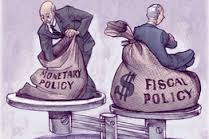
Fiscal Policy Cheat Sheet (Updated)

Fiscal Policy Cheat Sheet (Updated)
(Corrections, comments or critique, wcwaugh@aol.com)
The big change is the addition of how to explain what happens on the money market graph when there is expansionary or contractionary fiscal policy.


Tuesday, April 19, 2016

Fiscal Policy & Monetary Policy (Expansionary) (1of3)

Fiscal Policy Expansion & Monetary PolicyExpansion


Monetary & Fiscal, how do they work when used at the same time. Lets start by looking at what is the cause and effect of Fiscal and Monetary policy when both are expansionary.

When Monetary and Fiscal are both expansionary AD (increases) and the IR (no change).

How would this knowledge have helped us with the following question?

2008 AP Micro Exam
Answer - C
To bring the economy out of a recession, AD must shift right. 
Expansionary Fiscal & Monetary Policy can be used.
GS increases (expansionary fiscal) & a lowering of the Federal Funds Rate (expansionary monetary)
Of course you need to know that lowering the Fed. Funds Rate increases the MS.
If the FED lowers the Fed. Funds Rate banks can get loans at a lower rate and banks will therefore make more loans and create more money. (Expansionary)

From the Monetary Policy Cheat Sheet (Link)


2000 AP Micro 
Answer - C - Higher Interest Rates

Fiscal Policy tends to get higher interest rates.
Government Spending Increases and Consumption increases and Investment increases which shifts AD rightward which increases GDP and (Y) incomes and when incomes increases the Demand for Money increases pushing up the Nominal Interest rates and the government borrowing to spend money causes the Demand for loanable funds to increase thus driving up the Real Interest Rate.
or
Fiscal Policy Expansion causes AD to Increases and Interest Rates to Increase.


Saturday, April 2, 2016

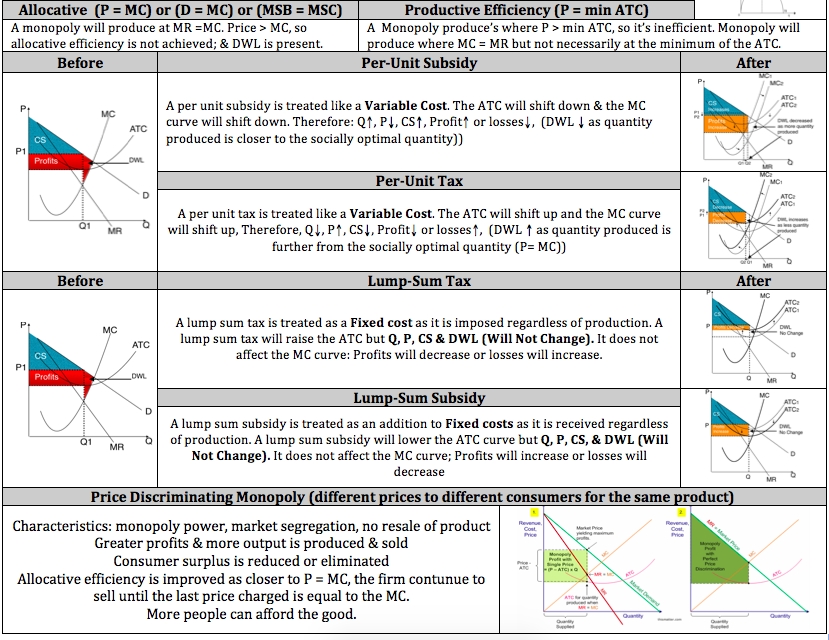
Monopoly cheat sheet

Monopoly Cheat Sheet
If you need a copy just send an e-mail. wcwaugh@aol.com

Thanks Hui Jing Seah

Thursday, March 31, 2016

2015 AP Macroeconomics FRQ #1

2015 AP Macroeconomics FRQ #1
Crying because he waited and crammed for the AP 
and now recognises that it is just to much information.

Watch me answer it on youtube https://youtu.be/lBuO7Jpm_pI


(A) Economy is operating below full employment,,, Draw a CLG of LRAS, SRAS, AD.
You must understand that below full employment means a recession graph.

(B) Assume the FED targets a new Federal Funds Rate to reach full employment. Should the Federal Reserve  target a higher or lower Federal Funds Rate?

1st you need to know what the FED funds rate is, so,, of the cheat sheet.


A lower Fed. Funds rate will entice banks to borrow and loan money at a cheaper rate. This will stimulate more loaning in the economy thus more money creation and therefore will ultimately push AD higher toward full employment.

Answer - One point is earned for stating that the Federal Reserve should target a lower federal funds rate.

(C) Draw a graph of the Money market (nominal interest rates) and the effect that part B had on it,

A lower federal funds rate will increase the level of borrowing between banks and more money creation will occur increasing the MS (money supply) which will lower the nominal interest rates.

Answer - 


(D) The policy makers pursue a fiscal policy rather than a monetary policy in part (B). Assume that the marginal propensity to consume is 0.8 and the value of the recessionary gap is $300billion.

(i) If the government changes its spending without changing taxes to eliminate the recessionary gap, calculate the minimum change in spending that is required.

So if the MPC is 0.8 the multiplier is 5

You have to know these formulas.

If the MPC is 0.8 then the MPS is 0.2 as they both together must = 1

So, 1/0.2 = 5,, the multiplier is 5

This means that the amount that government spends to correct the recession will be multiplied by 5.

If there is a 300b recessionary gap,, the government must spend 60 billion dollars 
because 60b X 5 =  300b.

Answer - One point is earned for calculating the minimum required change in government spending:$60 billion ($300/5=$60) 

(ii) If the government changes taxes with our changing spending to eliminate the recessionary gap, will the minimum required  change in taxes be higher, lower or the same as the change in government spending in part (D)(i)?

If unclear about the difference between the spending and the taxing multipliers then check out this blog post that specifically addresses the issue.

If the government doesn't want to increase spending (expansionary policy) it can reduce taxes (expansionary policy) but it will have to decrease taxes by more than 60b.

Why? To reduce taxes by 60b does mean that 60b of disposable income is now available to be spent by consumers but but but some of that 60b will be saved and thus leaked out of the economy, thus reducing the multiplying of the amount. 

Answer - One point is earned for stating that the minimum required change in taxes will be greater than the minimum required change in government spending.  One point is earned for explaining that the tax multiplier (mpc/mps = 0.8/0.2 = 4) is smaller than the government spending multiplier (1/mps = 1/0.2 = 5) because part of the initial increase in disposable income caused by the decrease in income tax will be saved rather than spent. 

(E) Assume the government lowers income taxes to eliminate the recessionary gap. Will each of the following increase, decrease or stay the same?

(i) AD explain.

AD will increase. Obviously if the government reduces taxes citizen's disposable income will increase and therefor consumption and investment will increase driving AD up.

Answer - One point is earned for stating that aggregate demand will increase and for explaining that lower income tax rates will increase disposable income and/or consumption and investment. 

(ii) Long Run Aggregate Supply, Explain

(Answer 1) Long run aggregate supply will not be affected (stay the same) as in the future government will have to borrow to make up the lack of tax revenue that cutting taxes cost. This scenario never assumes that government would cut taxes spending as governments never do.

Think of the LRAS (Long run aggregate supply) curve as the PPC curve,, what shifts the PPC outward is Technology, population, more resources found or trade. People having money not taken from them (taxes) doesn't change the fact that government would have spent that money also.

Arguments aside,, (we must) if the citizens spend the money or the government does,, won't affect the LRAS curve.

Answer 1 - One point is earned for stating that long-run aggregate supply will stay the same because lowering income taxes will increase consumption and/or investment, or there is no change in inputs.

(Understand that I like answer 1 the best,,, but find the one you understand the best)

(Answer 2) Long run aggregate supply will (increase) as with reduction in taxes, disposable incomes will increase causing more consumption and investment into capital intensive projects, (think technology) and therefore people working smarter and producing more per capita,,, shifting out of the PPC.

Answer 2 - One point is earned for stating that long-run aggregate supply will (increase) in the long run because lowering taxes will increase savings and investment in physical capital, or because of increased incentives to work.

(Answer 3) Long run aggregate supply will (Decrease) as in the future government will have to borrow to make up the lack of tax revenue that cutting taxes cost. This scenario never assumes that government would cut taxes spending as governments never do. If the government borrows to make up the difference in tax cuts then interest rates rise discouraging investment and consumption (crowding out). 

Answer 3 - One point is earned for stating that long-run aggregate supply will (decrease) in the long run because lowering taxes leads to a crowding out of private investment. 

Studied like a boss and got a 5


2015 AP Macroeconomics FRQ #2


2015 AP Macroeconomics FRQ #2


Watch me answer it here

Comparative Advantage

(A) Which country has an absolute advantage in producing solar panels?

I like to draw a graph for comparative advantage problems to see graphically the relationship between the production of the two countries.


 The most important point of these questions is to be able to tell if the problem is an output or an input problem. If you see the phrase, "using the same amount of resources" it's an output problem.

The phrase means that using the same input variables (resources) one country will be more efficient and will produce more than the other. (efficiency is key).

So, it is clear that with the same inputs (resources) that Country Y can produce more as 12 > 8 solar panels.

A knowledge of what absolute advantage is is helpful, from the cheat sheet.

Answer - One point is earned for stating that Country Y has an absolute advantage in producing solar panels.

(B) Calculate the opportunity cost of a furnace in country Y.

I always make a comparative advantage matrix to calculate these calculations.
So, Country X can make 6 furnaces or 8 solar panels
and, Country Y can make 6 furnaces or 12 solar panels

Since it is an output problem we use the over method.  
Output = Over

12 over the 6 and 6 over the 12
This will give us the opportunity cost or what is given up in terms of the good produced.

Understand that what is calculated (in that little box) is what is given up:
To produce 1 furnace we give up 2 solar panels
or said another way, in the other box
To produce 1 solar panel we give up half (.5) of a furnace

Answer - One point is earned for calculating the opportunity cost of a furnace for Country Y: 
2 solar panels per furnace. 

(C) Which country has the comparative advantage in producing furnaces? Explain.

To figure out the comparative advantage,, we must compare,, so, finish the matrix.

Helpful, if we know what comparative advantage is,, from the cheat sheet.

In comparing who has a comparative advantage it is (always) 
the one with the lowest opportunity cost
so, compare the opportunity cost of furnaces with furnaces
and the opportunity cost of solar panels with solar panels.
Compare columns.
Country X gives up (costs) 1.3 solar panels for every furnace produced
compared to 
Country Y gives up (costs) 2 solar panels for every furnace produced

Country X has the lower opportunity cost 
Country X should produce furnaces

Answer - Country X has the comparative advantage in producing furnaces
Country X has a lower opportunity cost of producing furnaces than Country Y. 

(D) If the terms of trade were that 2 furnaces are traded for 1 solar panel, should Country X produce solar panels domestically or import solar panels from Country Y?

As it stands right now, it costs Country X .75 of a furnace to produce 1 solar panel. To give up 2 furnaces for 1 solar panel would be a worse deal. So no deal.
Country X should produce  its own solar panels domestically.

Answer - One point is earned for stating that Country X should produce solar panels domestically.


Saturday, March 12, 2016

2004 Macro FRQ #3 (FED Buys Bonds/ Reserve Requirements)

FED Buys Bonds (Money Supply)
So, lately I was stumped in class.

The 2004 Macro FRQ #3

A) As a result of the FED's action, what is the change in the money supply if the required reserve ratio is 100%??

Answer - If the RRR is 100%, the amount held by the bank in Required Reserves is all $5000 dollars. But  the thing is,, the FED dropped $5,000 into the market initially by buying the bonds. That is where the increase comes from (the initial purchase of bonds from the FED)


B) If the Required reserve ration is reduced to 10%, calculate the following.
(i) The maximum amount this bank could lend from this deposit.

If the required reserve is reduced to 10%, then that means the bank is required to keep in reserve 10% of the $5,000 dollars deposited. So .10 x 5,000 = $500 in Reserve
This means that $4,500 of the amount deposited is put in excess reserves that can be loaned out. 
Answer (i) - So, the maximum amount that can be loaned out from the initial deposit of $5,000 is $4,500.

The part below is where I had a bit of a brain-fart.
(ii) The maximum increase in the total money supply from the FED's purchase of bonds.
The maximum increase in the money supply is happening from two different actions.
1) The bank is able to loan out the $4,500 and that amount is multiplied throughout the economy. We calculate this as 1/RRR = 1/.1 = 10,, so the $4,500 x 10 = $45,000 increase in the money supply. This is the amount of money that the banks can increase the money supply by the deposit. BUT,, there is someone we forgot about.
2) The FED had increased the money supply by buying bonds from our friends at the Clark Consulting Service of $5,000. 

Answer - the maximum amount the money supply can be increased is $50,000,, $45,000 from the actions of the bank and $5,000 from the initial buying of bonds from Clarks.


C) If the bank keeps some of its excess reserves how will this influence the change in the money supply? 

Answer - if the banks don't use all of there excess reserves to loan out,, then the money supply will not be increased by as much as it could. It would be less than the $50,000 of maximum increase.


D) If the public decides to not put the cash into the banks how will this effect the money supply?

Answer - this is the same as question (C),, if people don't put their deposits in the bank,, then the money supply cannot be increased. If Clark had just kept the $5,000 in cash,, then the money supply would only have increased by $5,000,, no more.


College Board, I salute you.

Thanks, Jung-Sub