Wednesday, January 18, 2017

2012 Multiple Choice (Output & Costs)

2012 Multiple Choice (Output & Costs)


Answer - (B) rise initially, but eventually fall


Answer - (D) Average fixed costs

Understand that AFC = FC/Q

Example - FC = $100 and we produce 10 units then AFC = $100/10 = $10 meaning that each unit we produce covers $10 of the fixed costs.
If....
FC = $100 and we produce 1000 units then AFC = $100/1000 = $.1 or 10 cents. meaning that each unit produced covers $.1 or 10 cents of the fixed costs.


Answer -(E) Its marginal cost is $6, and its average variable cost is $5.50

Understand that this is a perfectly competitive firm in long-run equilibrium,
this means that P=MC & P = min ATC
Total revenue is $600 and TR = P x Q
Quantity = 100 so Price must be $6
So if P = $6 then MC must equal $6 as P=MC
If P = min ATC then ATC at this level of production = $6
AFC = FC/Q
So, AFC = $50/100 = $.50 or 50 cents each unit
If ATC = AFC + AVC
&
ATC $(6) = AFC$(.50)
and ATC - AFC = AVC
Then AVC = $6 - $.50 = $5.50


Answer - (D) $400


AVC = VC/Q
Q = 5
 then ?/5 = an AVC of $100
VC = 500
500/5 = AVC $(100)
now,, with output of one more unit #6, AVC increases to $150
AVC = VC/Q
Q = 6
AVC = $150
so, ?/6 = $150
900/6 = AVC $(150)
&
900 = VC at output of 6 units
500 = VC at output of 5 units
MC = change in VC/ change in Q (output)
Change in VC = 400/ change in output  = 1 unit
400/1 = 400


Answer - (D) Output increases at an decreasing rate, 
and the cost of producing each additional unit of output increases

Understand that the College Board is trying to see if you recognise the effect of adding more labor (variable costs) to a fixed factor of production (factory)
Diminishing Returns/Productivity
As you add more inputs (labor, variable costs) 
to a fixed factor of production (factory, machinery)
revenues/output increase at a increasing rate initially, but at some point revenues/output decrease decrease the rate of increase, and will eventually decrease.


Answer - (E) Economic profits are zero because price equals average total cost

AVC = $35
AFC = $30
ATC = $65 & P = $65 & MC = $65
Long-Run Equilibrium = P=MC=ATC
at LR Equilibrium a firm is making zero economic profit


Answer - (D) Average revenue is less than average variable cost

Understand and draw your graphs with your Demand curve labelled the AR curve.
IT is,,, and therefore will make sense once drawn.


Answer - (E) greater than zero


Understand that if total revenue is increasing as output increases we must be operating in the elastic section of the demand curve.
As the lower section of the demand curve (that is where MR is negative) is inelastic


2012 Multiple Choice (Elasticity)

2012 Multiple Choice (Elasticity)


Answer - (C) The demand for peanuts must be price inelastic
Understand - If a portion of the peanut crop is destroyed then the price of peanuts will rise. If even with the rise of the price for peanuts, total revenue increases then the demand for peanuts must have been in the inelastic section of the demand curve.
from the Elasticity Cheat Sheet here.


Answer - (D) relatively inelastic (demand for labor)

This one tricked me.....

Understand - (((What they are saying!!))
The change in the price of labor is larger than the change in the quantity fired.


Answer - (C) Unit elastic

P x Q = TR (total revenue)

$8 x 400 = $3200(TR)
or

$4 x 800 = $3200(TR)

Therefore - Unit Elastic

2012 Multiple Choice (Public Goods)

2012 Multiple Choice (Public Goods)


Answer - (D) National Defense

Understand: public good - An item whose consumption is not decided by the individual consumer but by the society as a whole, and which is financed by taxation.

A public good (or service) may be consumed without reducing the amount available for others, and cannot be withheld from those who do not pay for it. 


From the Market Failure cheat sheet here.

One more thing - often the questions ask about the marginal cost of public goods.
The marginal cost of a public good is zero.
Adding one more person to our National Defense is zero.


Friday, January 13, 2017

2012 Multiple Choice (Monopoly, Natural Monopoly, Monopolistic Competition)

2012 Multiple Choice 
(Monopoly, Natural Monopoly, Monopolistic Competition)
Monopoly Cheat Sheet here
Monopolistic Competition Cheat Sheet here

Natural Monopoly 
Answer - (C) Long-Run ATC decrease as output increases

This is a recognition problem,
What is a natural monopoly?
For a natural monopoly the long-run average cost curve (LRAC) falls continuously over a large range of output. The result may be that there is only room in a market for one firm to fully exploit the economies of scale that are available
There are several interpretations of what a natural monopoly us
  1. It occurs when one large business can supply the entire market at a lower price than two or more smaller ones
  2. A natural monopoly is a situation in which there cannot be more than one efficient provider of a good. In this situation, competition might actually increase costs and prices
  3. It is an industry where the minimum efficient scale is a large share of market demand such there is room for only one firm to fully exploit all of the available internal economies of scale
  4. An industry where the long run average cost curve falls continuously as output expands
  5. Private utilities are natural monopolies in local markets
The key point is that a natural monopoly is characterized by increasing returns to scale at all levels of output – thus the long run cost per unit (LRAC) will drift lower as production expands. LRAC is falling because long run marginal cost is below LRAC. This can be illustrated in the diagram above. There may be room only for one supplier to reach the minimum efficient scaleand achieve productive efficiency.


Monopoly
Answer - (A) exit if conditions do not improve in the long-run
The firm is making losses, but shouldn't shut-down as it is still covering its fixed costs.

Monopoly
Answer - (B) produces to little output and sets a price above marginal costs


 Monopoly Competition
Answer - (C) P = ATC, MR = MC, and P > MC

Recognition Problem
The ATC curve is tangent to the Demand curve, it does operate at profit max (MR = MC), and price is greater than MC, therefore not allocatively efficient.


Monopolistic Competition
Answer - (B) make the demand for its product less elastic

Advertising in a Monopolistically Competitive market is a way
to entice customers to buy the firms products. 
It also attracts customers away from other firms.
If customer know about your products, then the assumption is that the firms demand curve is a bit more inelastic.

Amos Web does a fairly good job of explaining this concept.


I need to do a better job on my cheat sheets for 
monopolistically competitive, natural monopolies, regulated monopolies 


Thursday, January 12, 2017

2012 Multiple Choice (Market Failure) Externalities

2012 Multiple Choice (Market Failure) Externalities
Market Failure (externalities) cheat sheet here.


Answer - (B) Subsidies the producer

Understand that the Government really can only do two things: tax or subsidies.
If it a positive externality, we want more of it....
So society subsidises the production of the good


Answer - 59 (D) 
Answer - 60 (B)


2012 Multiple Choice - (Perfect Competition)

2012 Multiple Choice - (Perfect Competition)

I want to believe in Perfect Competition.


Answer - (C) I and IV

Understand that the firm above/below is making profits.
P > ATC = Positive Economic Profits
In the Long-Run Firms enter the industry hunting for profits.
SSSHHHH... I'm hunting for Pwofits.


Answer - (D) Perfectly Competitive Q3

Recognise that the perfectly competitive's firms Total Revenue Curve is upward sloping
and continuous as they can sell all they want at the market price.
Understand that at the quantity where TC is furthest away from TR on the graph is Profit max.


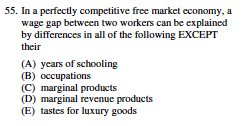
Answer - (E) tastes for luxury goods

WTF!!!!

(A) years of schooling (YES) different wages due to different human capital
(B) Occupations (YES) Obviously the doctor receives more than the bus driver
(C) Marginal Product (S) of workers (YES) workers can be paid different wages based on MP,, at some point someone gets paid a salary of zero, as they aren't hired... 
Yes,, that is a weak explanation..
(D) Marginal Revenue Products (Yes) possibly different firms, different salaries, as the MRP is MP * P (price of the good) so a higher price could lead to larger wages as firms try and hire enough labor to  meet the quantity demanded.
(E) Tastes for Luxury Goods (NO) Someone's desire for luxury goods does not change the wages between workers.


2012 Multiple Choice - (Gini Coefficient/ Progressive Taxation)

2012 Multiple Choice - (Gini Coefficient/ Progressive Taxation)


Welker - Video


Answer - (B) More progressive income tax

Understand that incomes are earned,, distribution is what the government does so in actuality wealth is distributed not incomes.

If someone steals from me their wealth might have increased 
but to call that income is offensive.

Answer - (E)

This a simple recognition problem. Understand that they don't want you to calculate the percentage differences between the before/after incomes.

These gini coefficient and progressive tax questions are mostly recognition questions.

I hate these questions...